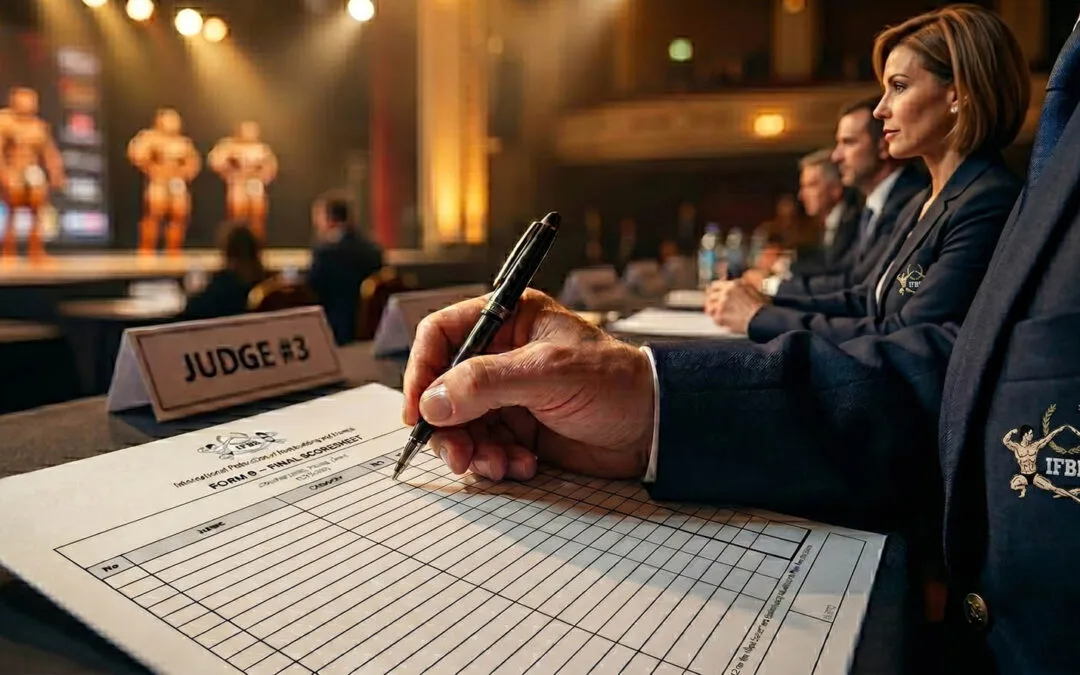
You have prepared for months. Your posing is sharp and your physical conditioning is at its peak. But the moment you step onto an international stage, you enter a rigorous system where judging criteria and statistical formulas decide the final outcome. Understanding the official evaluation and scoring protocol of the IFBB (set out in its Section 1: General Rules) is essential to interpret the official classification, understand how the panel evaluated you, and make the right adjustments for your next competition.
1. Competition Rounds by Athlete Count & Official Documents
In the IFBB, the flow of the contest follows a structured protocol based on the number of registered athletes in each class. Contrary to widespread belief, not every round involves numerical scores:
Elimination Round
Judges do not award points. Each judge places an "X" next to the 15 athletes they believe should advance. The top 15 with the most votes move on to the Semifinals. Athletes who do not qualify are eliminated without points.
Semifinals (Round 1)
Comparisons in quarter turns and mandatory callouts. Each judge awards individual placings from 1st to 15th. High and low outlier scores are discarded, and only the top 6 athletes qualify for the Finals.
The Grand Finals
Clean slate: all finalists start with 0 points. Everything that happened in the semifinals is discarded. The 6 finalists are judged with a fresh perspective to decide the podium and medal positions.
2. How Judges Score: Why the Lowest Numerical Score Wins
A common misconception among competitors and fans is assuming that judges give grades (like an 8/10 or 9/10). In the IFBB, judges assign individual ranking positions:
If a judge ranks you as the best in the comparison, they give you 1st place (1 point). If they rank you second, you receive 2nd place (2 points), and so forth. Consequently: the competitor with the lowest total score wins the championship.
Odd Panels & The Exact Discard Rules
To prevent deadlocks, judging panels are always composed of an odd number of official judges. However, the discard formula varies depending on the scale and tier of the event:
- Official International Championships (9 Judges): At major events (World Championships, Continental European Championships), the statistician table discards the 2 highest scores (the worst places you were given) and the 2 lowest scores (the best places). The remaining 5 central scores are added together.
- Diamond Cup, Opens & Regional Contests (5 or 7 Judges): With fewer judges on the panel, discarding 4 scores would leave too few valid evaluations. The official rules therefore specify that only the 1 highest and 1 lowest score are discarded, adding the remaining scores together.
Statisticians' Score Sheet (Official Form 5)
| Bib # | Finalist Competitor | J1 | J2 | J3 | J4 | J5 | J6 | J7 | J8 | J9 | Subtotal | Place |
|---|
3. Breaking Ties: The Relative Placement Method (The Dot Method)
Even with an odd panel and discarded extremes, it is very common for two competitors to finish with identical subtotal scores (for instance, both finalists ending with 11 points after discards). In this scenario, the IFBB relies strictly on the Relative Placement Method.
The statistical team retrieves the original individual sheets from every judge on the panel and conducts a head-to-head column-by-column comparison:
| Finalist Competitor | Tied Subtotal | J1 | J2 | J3 | J4 | J5 | J6 | J7 | Dots (Head-to-Head) | Official Outcome |
|---|---|---|---|---|---|---|---|---|---|---|
| #42 Elena (Bikini A) | 11 pts | 2 🔴 | 3 | 2 🔴 | 2 🔴 | 4 | 2 🔴 | 3 | 4 of 7 Judges | 🥈 Silver Medal (2nd) |
| #45 Sofia (Bikini B) | 11 pts | 3 | 2 🔴 | 3 | 3 | 2 🔴 | 3 | 2 🔴 | 3 of 7 Judges | 🥉 Bronze Medal (3rd) |
The procedure: Statisticians place a red dot (dot) directly over the number of the athlete who was placed higher by that specific judge. In the table above, although both Elena and Sofia finished with identical 11 points after discards, Elena (#42) won the head-to-head vote with 4 out of 7 judges, breaking the tie decisively in her favor.
Division Exceptions (Priority on Physique Rounds)
In divisions where both muscularity and an artistic or wardrobe facet are evaluated, total score ties do not immediately trigger relative placement. First, preference is given to the round evaluating pure physique (quarter turns), and only if the tie persists in that subscore is the dot method applied:
- Women's Fit Model: Semifinal and final ties are broken by looking first at the subscore of the swimsuit/monokini round (Round 2 or Round 4), giving priority to muscular presentation over the evening gown round.
- Women's Acrobatic & Artistic Fitness: Quarter-turn physique rounds (Round 2 and 4) take priority over the routine rounds.
- Mixed-Pairs: Mandatory posing rounds take precedence over choreographic scoring.
4. Mastering the "Total Package"
As competition level intensifies, muscular discrepancies among finalists narrow significantly. At this tier, the podium is decided by the Total Package:
- Posing Fluidity & Control: Clean transitions without wobbling, maintaining flawless breath control and isometric tension without showing visible strain.
- Stage Presence & Connection: Genuine confidence, eye contact with the judging panel, poised shoulders, and an effortless walk.
- Aesthetics & Official Suit Standards: Even, non-streaky tan, hairstyles that do not obstruct the upper back or lat spread, and a competition bikini that complies fully with official IFBB gluteal coverage rules.
Ready to Leave Zero Doubts in the Judges' Minds?
Perfect every angle of your mandatory poses before stepping onto the international stage with our dedicated coaching and tools:
Evaluate Your Posing with Artificial Intelligence on Your Phone
Download the official Posing AI Coach App on iOS and Android. Analyze your quarter-turn angles with precision and try on competition bikinis virtually with AI.
📲 Get the App & Claim 5 Free Credits