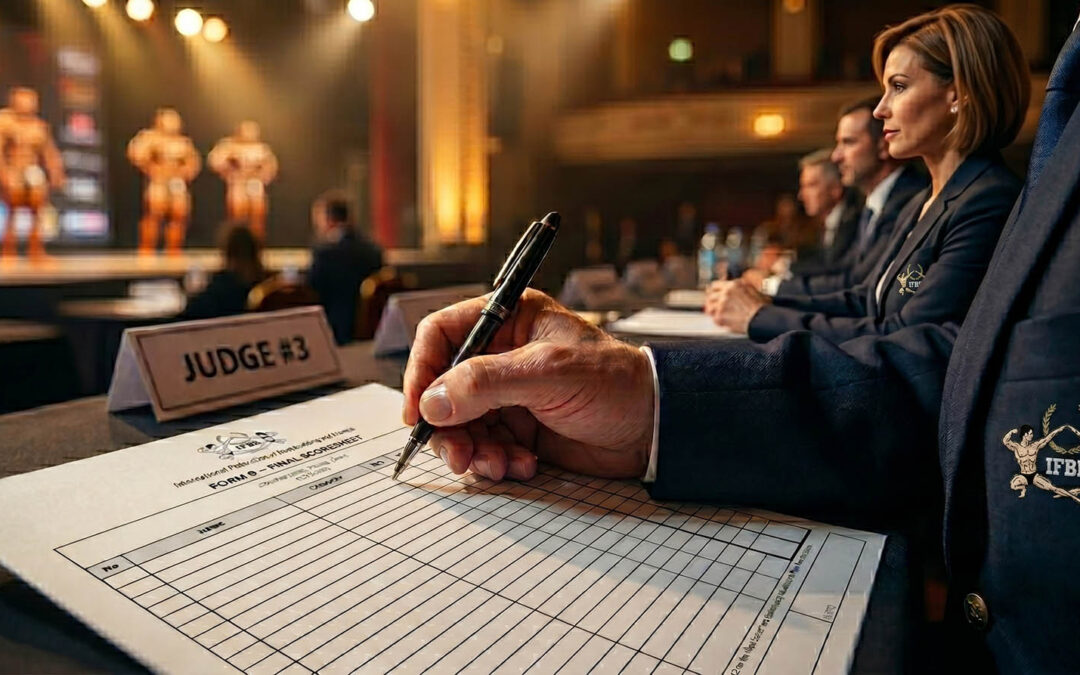
You have been preparing for months. Your posing is excellent and your condition is at its best. But when you step onto the international stage, you enter a system where the criteria and evaluation of the judges are what dictate the result. Understanding the scoring system is vital to know how to interpret the final ranking and how you were evaluated by the judges panel.
1. Rounds According to the Number of Athletes
In the IFBB, the flow of the competition depends on the number of participants, although the Head Judge always has the final word according to the circumstances of the event:
- More than 15 athletes: An Elimination Round is held. Judges select their 15 favorites using an "X". If there are ties for the 15th spot, those athletes also advance to the next round, meaning the semifinals could have more than 15 competitors. Those eliminated here appear without points on the lists.
- 8 to 15 athletes: Generally, the competition starts in the Semifinal Round. However, depending on the competition, the organization might decide to reduce the group (for example, to a Top 10) before the finals.
- 7 athletes or fewer: The competition goes directly to the Final Round. There are no semifinals; the athletes go straight to the final round that will decide the podium positions.
2. How Do Judges Score?
It is a common misconception to think that judges give scores/grades to each athlete. In reality, judges assign an individual ranking position to each athlete.
If a judge considers you the best in the lineup, they award you first place (1 point). If you are second, 2 points, and so on. For this reason, the athlete with the lowest total score is the one who wins.
The Discard Rule and the Odd-Numbered Panel
To guarantee impartiality, the judging panel is always an odd number (5, 7, or 9 judges). This prevents ties or deadlocks in decisions. To calculate the final sum for each athlete:
- The highest score (the worst position received) is discarded.
- The lowest score (the best position received) is discarded.
- The rest of the scores from the other judges are added together.
🔍 "Blind" Competition
As an athlete, you compete without knowing your score. The callouts (comparisons) and rotations are your only visual clues, but the actual result is only revealed at the end. This uncertainty forces you to maintain maximum tension and competitiveness until the last second.
3. How is a Tie-break Resolved?
Despite the odd-numbered panel, it is possible for two athletes to end up with the same total score on their card. In that case, the Relative Placement Method is applied.
The system reviews the individual sheets of all judges and compares the tied athletes head-to-head. If the majority of the individual judges preferred Athlete A over Athlete B, the tie is broken in favor of the former. It is a direct judge-to-judge comparison that always yields a winner.
It is important to clarify that this system is used in the majority of categories, but there are some that operate slightly differently.
In disciplines that evaluate the athlete in different facets (physique/swimsuit vs. choreographic routines/evening gown), ties in total scores (Prejudging or Finals) do not directly apply relative placement. First, the subscore of a specific round (almost always the round that purely evaluates the physique) is prioritized. Only if the tie persists in that specific round is the relative placement method used as a last resort:
- Women's Acrobatic Fitness: Total ties are broken by prioritizing the subscores of Round 2 (for prejudging) and Round 4 (for finals), both being the physical evaluation in quarter turns.
- Women's Fit Model: Ties in prejudging and finals are broken by looking first at the subscores of Round 2 and Round 4, respectively, which correspond to the swimsuit rounds (leaving the evening gown round in the background).
- Women's Artistic Fitness: Works the same way, prioritizing the subscores of Round 2 and Round 4 (quarter turns) over the artistic routine rounds.
- Men's and Women's Fitness: The tie is broken by prioritizing the subscore of Round 2 (prejudging) or Round 4 (finals), both focused on quarter turns.
- Mixed-Pairs: Total ties are broken by prioritizing the rounds of joint mandatory poses: Round 1 for prejudging and Round 3 for finals.
- Wheelchair Bodybuilding: The tie in the "Final Score" (which sums the mandatory poses and the free routine) is broken by prioritizing the subscores of Round 2 (Mandatory Poses).
4. Controlling the "Total Package"
Controlling every detail is fundamental to improving the Total Package result. We must keep in mind that all athletes arrive with the best physique possible, and the higher the level of the competition, the more small details count in deciding who takes the victory.
- Elegance and presence: Your attitude during rotations must be flawless.
- Maintaining condition: The physique must look just as tight from the first comparison until the very last second.
- Overall aesthetics: The fit of the bikini or trunks, hair, makeup, and tan must form a professional and harmonious image.
Do you want to dominate the stage and leave no doubt for the judges?
Secure your best version with my professional resources and coaching:
📩 Download my New IFBB Posing Guide for FREE 🗓️ Check the IFBB Calendars 🏆 Book your Personalized Posing Session 🎓 Train as a professional and get your international IFBB certificate
Juan B. Morales
- Posing Coach
- tenuncuerpo10.com owner
- IFBB Official Press Member