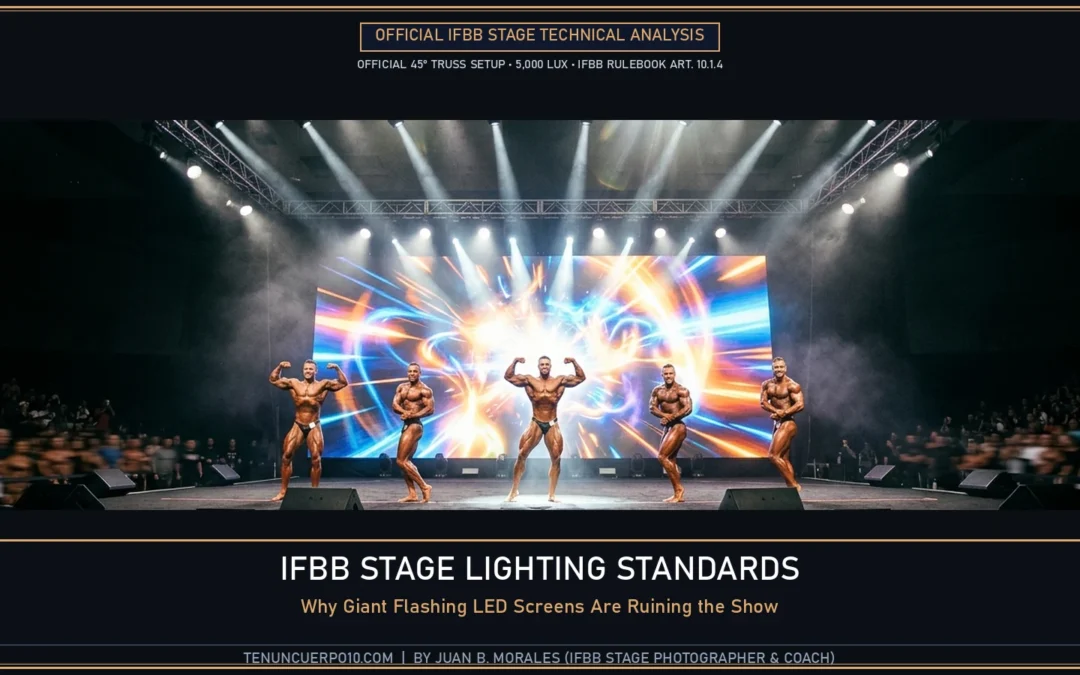
Let’s talk about a growing trend that is quietly ruining bodybuilding and fitness stages: giant LED screens placed right behind the athletes.
As a stage photographer and videographer, and as a prep coach for athletes competing in the IFBB circuit, I see this everywhere now. Promoters use LED walls to showcase sponsors, and from a business standpoint, I completely get it: selling digital advertising space pays the bills.
However, when that LED screen is constantly flashing, animating, or jumping from dark graphics to blinding white sponsor slides right behind the competition line, it utterly destroys the visual quality of the show. Worse yet, it severely compromises the two most important groups in the venue: the athletes and the judges.
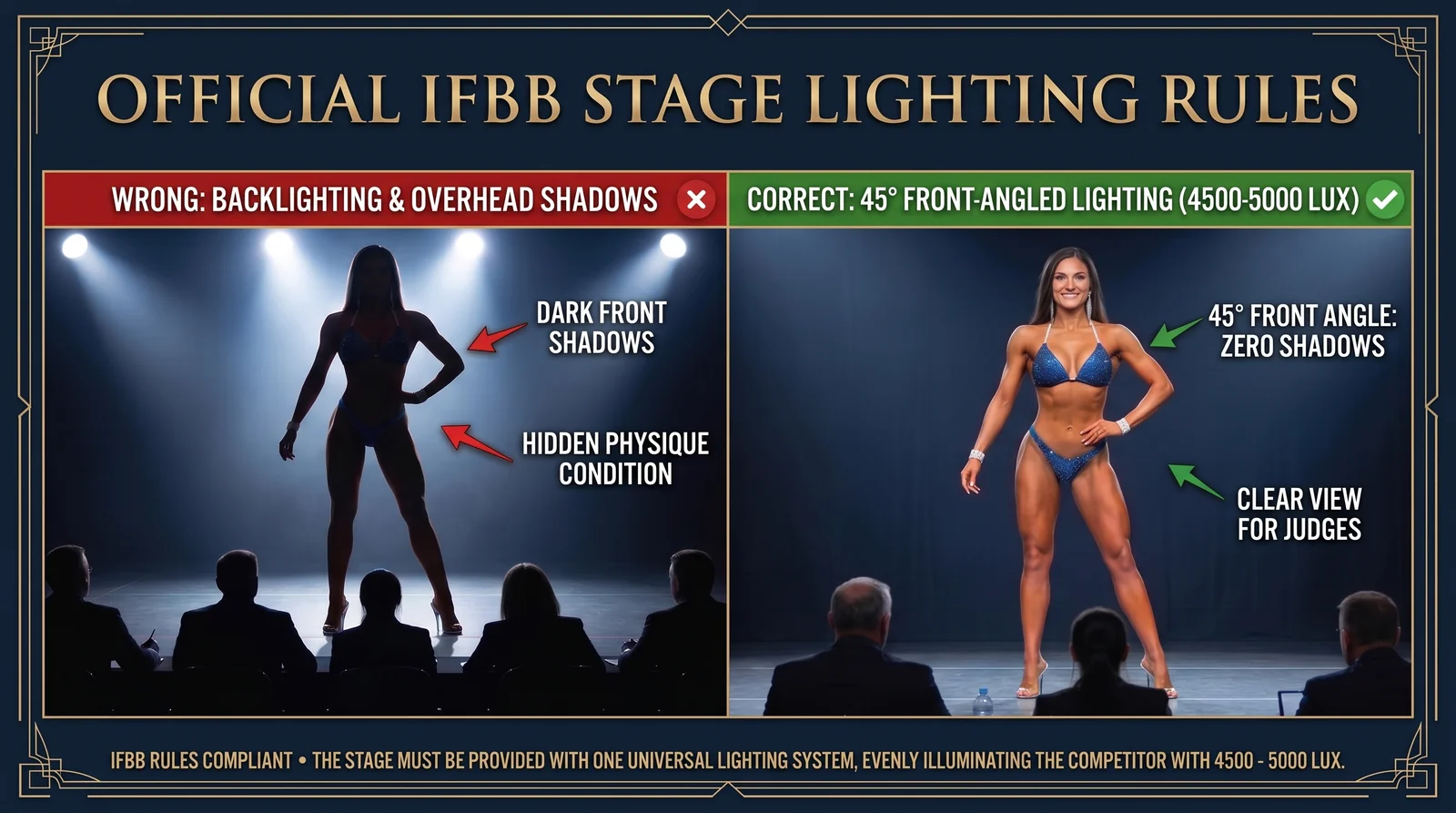
1. The Camera Disaster: From Sculpted Physiques to Dark Silhouettes
From a photographic and optical physics perspective, placing a high-output LED screen directly behind an athlete produces violent, unmanageable backlighting.
Digital camera sensors possess limited dynamic range compared to human vision. When a background emits thousands of nits of direct light straight into the lens, the camera’s metering system instantly stops down exposure to protect highlights. The immediate consequence? The athlete turns into a flat black silhouette. Stage tan disappears, muscle fullness flattens out, and months spent carving deep striations, glute separation, and razor-sharp conditioning vanish into muddy, crushed shadows.
In still photography, a skilled shooter can occasionally overpower the backlight with off-camera strobe flashes or recover shadows in post-production (at the expense of digital grain and noise). But in live stage video, official YouTube streams, and high-engagement social media reels, there is zero salvation: what the camera captures is an unrecognizable dark shadow dancing in front of a giant flashing TV set.
2. The Critical Injustice for Judges: How Can You Score What You Cannot See?
If this is a logistical nightmare for media creators, for the official judging panel it represents an unacceptable compromise of sporting fairness.
Let’s ask ourselves frankly: how can an IFBB judge accurately evaluate muscle separation, symmetry, glute tie-ins, and conditioning when a blinding white sponsor slide is strobing 15 feet away, right behind an athlete’s waist?
The human iris constricts automatically in response to the brightest light source in its visual field. When judges look up at the stage, the searing screen background forces their pupils shut, heavily degrading their ability to distinguish subtle muscular density and fiber striations illuminated by front fixtures.
«An athlete in Bikini, Wellness, Men’s Physique, or Bodybuilding endures 16 to 24 weeks of grueling sacrifice: tracking every ounce of food, grinding through fasted cardio, depleting water during peak week, and investing thousands of dollars in travel, entry fees, and custom stage wear. It is completely unacceptable for months of relentless discipline to be ruined in 30 seconds because the venue put the light behind the competitor instead of on them. The athlete is the sole reason the event exists; moving sponsor graphics belong on side screens or during category intermissions.»
3. Beyond the Critique: Media Distribution & Actionable Solutions for Promoters
The success of any fitness and bodybuilding championship relies on countless moving parts: adhering to strict run times, supporting athletes backstage, providing fan comfort, and facilitating fair scoring for judges. But in today’s digital era, there is a strategic reality that almost nobody thinks about: media distribution and social media reach.
Bodybuilding and fitness are not mainstream televised sports that lead the evening news like football or basketball. The vitality, commercial sponsorships, athlete recognition, and audience growth of our sport depend almost 100% on what is broadcast across Instagram, TikTok, and YouTube. For the thousands of fans, family members, and prospective competitors who couldn't attend in person, the photos and videos taken on stage are literally all they will ever see. If that footage is dark, blown-out, or silhouettes the competitors, the global reputation and market value of the entire show plummet.
My goal in opening this discussion is not to stay in sterile criticism, nor to demand an outright ban on LED screens. Modern stage technology is visually spectacular and adds immense entertainment value. But we must deploy LED walls in a way that elevates the championship rather than sabotaging it.
Key Variables & Actionable Proposals for Event Promoters:
- Stage Depth Changes Everything: On a deep, professional stage (with 8 to 10 meters between the competition line and the back wall), light falloff naturally softens the screen's output, significantly reducing backlighting. The disaster happens on shallow stages where the LED wall is installed barely 3 meters (10 feet) behind the athletes, functioning like a stadium floodlight aimed right at the camera lenses.
- Flanking Side Screens for Dynamic Ads & Live IMAG Feeds: Promoters need to satisfy commercial sponsors who pay for looping video ads and rotating logos. The ideal production solution is moving dynamic LED walls to the sides of the stage. Sponsors receive massive visibility from the audience, while the central judging axis and primary camera angles remain 100% clean. Furthermore, flanking screens are ideal for broadcasting a live close-up camera feed (IMAG) so audience members in rows 20 through 50 can appreciate striations and facial composure up close.
- The Ideal Central Backdrop: Fixed Architectural Decor & Elevated Logos: I have documented outstanding events that utilize an elegant fixed central set: architectural columns, neutral matte framing, or a smooth backdrop featuring the official championship emblem positioned just above head level. This design ensures that every official podium picture, overall champion trophy presentation, and award ceremony captures the championship brand in pristine clarity—generating thousands of viral social media shares without a single harsh reflection.
- Transition Protocol for Central LED Walls: If a venue must use a central rear LED wall due to physical hall constraints, it should remain locked on dark, low-brightness, static graphics while athletes are onstage. Dynamic video commercials and bright sponsor reels should run strictly between categories when the stage is empty.
4. What Official IFBB Rules Explicitly Mandate (Art. 5.1 & 10.1.2)
This is neither a matter of subjective taste nor an artistic complaint. The IFBB Constitution & Technical Rules outline strict, binding mandates regarding stage backdrops:
- Neutral Matte Dark Blue or Black Backdrop (Art. 5.1 & 10.1.2): The stage background must be of a non-reflective, neutral matte dark blue or solid black. It must remain free of visual distractions that compromise camera sensors or judicial focus.
- Prohibition of Central Rear Advertising: Official rules strictly prohibit active promotional displays, blinking billboards, or high-contrast graphics placed in the central rear area behind the athletes during judging.
- Mandatory Protocol for LED Video Walls: If a promoter chooses to incorporate an LED video wall on stage, the screen must display a static, low-brightness, dark graphic while athletes are onstage. All animated sponsor reels, looping commercials, and high-luminance white backgrounds must be confined to auxiliary side screens or broadcast exclusively during category changeovers and pauses.
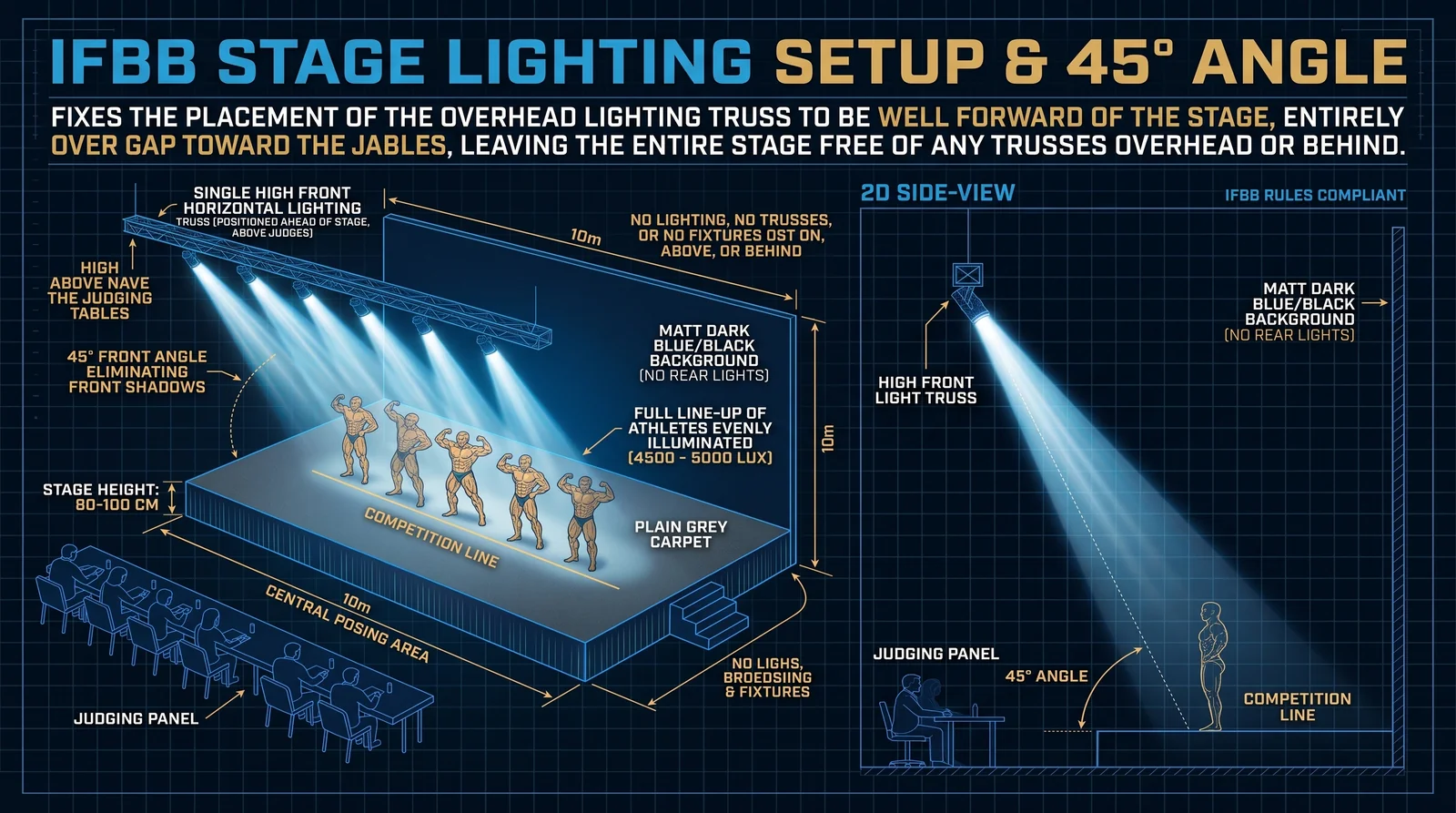
5. The Ideal IFBB Stage Lighting Setup (Art. 10.1.4)
To ensure every competitor receives optimal evaluation, Article 10.1.4 of the IFBB Technical Rules specifies the exact engineering and structural parameters required for world-class stages:
A. 45° Front-Angled Overhead Lighting (High Front Truss)
Lighting fixtures must never be positioned directly overhead (pure top-down lighting casts harsh, unflattering shadows under eyebrows, collarbones, pecs, and glutes). Nor should lights be placed low on the floor pointing upward.
Instead, promoters must hang a single high horizontal lighting truss positioned forward of the competition line, suspended over the gap directly above the judging panel. From this vantage, fixtures angle downward at 45° toward the athletes, delivering between 4,500 and 5,000 lux of pure, clean white light. This 45° angle completely eliminates front shadows while accentuating muscle separations and physical striations in full three dimensions.
B. The Two Priority Lighting Zones
If an event hall has technical limitations preventing uniform coverage across the entire perimeter, the production crew must prioritize two critical areas:
- Full Line-Up Uniformity: Consistent, balanced light intensity across the entire line-up so athletes on the wings receive the exact same lux rating as those in the center.
- 10-Meter Shadow-Free Central Corridor: A central posing zone measuring 10 meters wide, stretching from the front edge of the stage to the rear wall, reserved for official callouts, comparisons, quarter turns, and individual posing routines (I-walks and posing routines).
C. Stage Floor & Regulatory Height
- Matte Non-Reflective Carpet: The stage floor must be covered with a plain, non-reflective carpet in neutral grey or dark blue. Glossy lacquered wood, polished stages, or reflective plastic wraps are strictly forbidden because they bounce glare upward into athletes' skin and cameras.
- Stage Elevation (80 to 100 cm): Ideal stage height ranges between 80 cm and 1 meter. If a stage exceeds 100 cm in height, the judging tables must be raised onto an elevated riser. This guarantees judges' sightlines remain unobstructed, allowing them to assess calves, ankle lines, footwear, and feet without visual clipping.
6. Technical Comparison: Regulatory IFBB Setup vs LED Screen Errors
| Stage Parameter | Official IFBB Standard (Compliant) | Common LED Screen Mistake | Impact on Athlete & Judging |
|---|---|---|---|
| Backdrop Surface | Compliant Matte dark blue or solid black, zero rear illumination. | Incorrect Active LED video wall cycling sponsor logos and bright white banners. | Extreme backlighting. Athletes crushed into silhouettes; severe eye fatigue and glare for judges. |
| Truss Positioning | Compliant Overhead horizontal truss placed forward over judges, 45° angle down. | Incorrect Fixtures placed directly above athletes’ heads or from behind. | Harsh eye socket and chest shadows. Muscular depth flattens and definition appears washed out. |
| Light Output (Lux) | Compliant 4,500 to 5,000 lux evenly distributed across the line-up. | Incorrect Spotlight hot spots in the center, dark dead zones on outer edges. | Unfair playing field: center athletes look ripped and lean while outer athletes look soft and unlit. |
| Stage Flooring | Compliant Matte non-reflective carpet in solid grey or dark blue. | Incorrect Glossy wood or reflective vinyl reflecting LED colors upward. | Parasitic color cast onto competition tan, corrupting true skin tone and definition. |
| Judges' Sightlines | Compliant 80–100 cm height (judging tables raised if stage exceeds 1m). | Incorrect Over-tall stages (>1.2m) without raised judge risers. | Judges cannot see calves, footwear, or foot placement, compromising complete head-to-toe scoring. |
📲 Master Your Posing and Inspect Your Angles Before Stepping Onstage
You cannot control whether a promoter sets up an LED screen, but you can control 100% of your posing execution, angles, and symmetry under the lights. With the official Posing AI Coach app, get instant real-time stage voice feedback for all IFBB divisions, and preview regulatory suits with the Virtual AI Bikini Fitting Room.
🎁 5 Free Welcome Credits instantly upon downloading the app.
💡 Exclusive Sara AI Bonus (+5 Extra Gift Credits): Open our intelligent voice assistant Sara (floating widget at the bottom right of TenUnCuerpo10), tell her your in-app Nickname, and she will immediately activate 5 additional bonus credits (10 total credits to complete your virtual trials and posing evaluations).
Prefer to discover all AI posing features first? Discover all details of Posing AI Coach here →
7. Frequently Asked Questions (FAQ)
Why do background LED screens hurt athletes' scores so badly?
They generate intense backlighting that constricts judges' pupils and forces cameras to underexpose, turning athletes into dark, detail-free silhouettes. Judges cannot evaluate muscle separation, glute condition, symmetry, or vascularity when a bright screen is flashing behind the athlete's waist.
What does the official IFBB rulebook mandate for stage backdrops?
Articles 5.1 and 10.1.2 require a neutral matte dark blue or solid black background with zero rear lighting. Promotional graphics are prohibited in the center rear. If an LED wall is used, it must display a dark, low-brightness static graphic while athletes are onstage, keeping moving ads on side screens or between categories.
What is the ideal lighting configuration according to IFBB Art. 10.1.4?
A single high horizontal truss positioned forward of the stage above the judging tables, angling lights down at 45° with 4,500 to 5,000 lux. This 45° angle completely eliminates front shadows and gives full three-dimensional clarity to muscular lines.
What are the height and flooring rules for IFBB stages?
Stages must be 80–100 cm high with a plain matte non-reflective carpet (grey or dark blue). If a stage exceeds 1 meter, the judges' tables must be placed on an elevated riser so judges don't lose sight of the competitors' calves, feet, and ankles.
Related Official IFBB Guides:
- How Do Judges Score at IFBB Championships? Learn How the Scoring System Works →
- IFBB Competition Bikini Guide 2026: Official Suit Rules, Standards & Colors →
- Official IFBB Competitions Calendar 2026: Dates, Venues & Inspection Reports →
- Free IFBB Posing Guide: Stage Presentation Keys for Competitive Athletes →